

ABOUT US
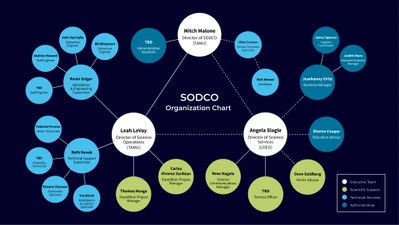
SODCO is a collaboration between Texas A&M University (TAMU) and the Lamont-Doherty Earth Observatory (LDEO), led by Director of SODCO Mitchell Malone, Director of Science Services Angela Slagle, and Director of Science Operations Leah LeVay. SODCO will also provide support for a new Site Survey Databank (SSDB) at Scripps Institution of Oceanography, led by Karen Stocks.
SODCO at TAMU will assist principal investigators with creating drilling proposals; identifying suitable drilling platforms, coring tools, and logging tools; working with the scientific community to advance new technologies; and planning and implementing expeditions. SODCO at LDEO will provide research community support services for successful planning and execution of expeditions, including pre-drilling activities, planning and training workshops, and science communications. LDEO will also continue to provide the Logging Database (LogDB).
SODCO will be guided by a community advisory board and two panels. The SODCO Advisory Board (SAB) will provide overarching guidance, the SODCO Safety and Environmental Panel (SSEP) will oversee safety through site evaluation, and the SODCO Engineering and Technology Advisory Committee (SETAC) will foster innovation in engineering and technology development.
All drilling proposals will be submitted to the National Science Foundation's (NSF) Sub-Seafloor Sampling Program. Information on proposal submissions will be detailed in a forthcoming announcement from NSF.

ADVISORY STRUCTURE
An overarching advisory structure for SODCO is critical for ensuring that the scientific ocean drilling (SOD) science community continues to set the course for U.S. SOD. The invaluable knowledge and experience of the science community will play a vital role during the next stage of U.S. SOD. This is best accomplished through an active and engaged advisory committee structure that represents the full range of ocean science community interests and that solicits and synthesizes community input. This structure will ensure that community members are able to advance U.S. research interests in a broad and systematic fashion and that they are informed about program developments and opportunities.
The SODCO Advisory Board (SAB) is charged with formulating long-range scientific and policy recommendations pertaining to U.S. SOD, evaluating SODCO operations and accomplishments, reviewing community proposals and applications related to SOD, providing advice to SODCO, and stimulating and coordinating broad participation by an active SOD community within the U.S. through outreach and community-building activities.
The SAB comprises 15 U.S.-based members from a wide range of career stages with broad institutional representation. The SAB will meet in person twice a year with additional board or subcommittee meetings held remotely, if required.
Learn more about the SODCO Advisory Board

The SODCO Safety and Environment Panel (SSEP), consisting of members from industry and academia, will evaluate drill sites through an open review with the principal investigators and SODCO office. These members will have a range of applicable expertise to thoroughly review each proposed drill site to reduce/eliminate the risk of release of substantial quantities of high-pressure fluids or volatiles from the subsurface. This panel will meet one to two times per year and provide near real-time feedback should issues arise while operating.
As a mechanism for fostering innovation and exploring new drilling and borehole technologies, the SODCO Engineering and Technology Advisory Committee (SETAC) will be tasked with identifying new directions for SOD subseafloor tool development and assisting with implementation of ideas from the broader community. Comprising experts across both industry and academia, the panel will work closely with the SODCO operations and engineering team.
ENGAGEMENT
U.S. SCIENCE COMMUNITY SUPPORT
SODCO will support the scientific community in planning and workforce development, through pre-drilling, early-career engagement, and training activities.
A range of pre-drilling activities will be supported by SODCO, including informational webinars aligned with NSF calls for drilling proposals, workshops on scientific drilling (broad and general or specialized, depending on community needs), and scientific drilling primers ("Drilling Proposals 101") to engage early-career researchers and provide opportunities to those new to scientific ocean drilling.
SODCO will also support projects that facilitate the implementation or enhance the outcomes of planned expeditions, including assembling newly acquired data from a region of interest, developing capabilities to carry out high-impact, non-routine measurements on a SODCO-implemented expedition, and developing community resources to increase the impact of an expedition. Funding will be available through an Innovation Grants Program for research projects that encourage advancements in science and technology, using cutting-edge scientific/engineering techniques and approaches to scientific questions, or creative methods to address other community needs.

Community-led workshops are instrumental in gathering ideas, developing strong drilling proposals, and promoting successful engagement in drilling planning. SODCO will work with the SODCO Advisory Board (SAB) to identify high-level workshop needs in response to U.S. priorities. SODCO will solicit proposals from the community for workshops that explore questions that can be addressed with SOD, assess available data sets to identify sites for future drilling or gaps in data where site surveys may be required, or synthesize preliminary results to maximize the scientific achievements from previous drilling.
Training and career development opportunities are key priorities for the U.S. SOD, to ensure that knowledge and expertise continue to be passed on. SODCO will develop a range of training courses and workshops that will take advantage of the resources available at the Texas A&M (TAMU) Gulf Coast Repository (GCR) and at the Lamont-Doherty Earth Observatory (LDEO). Lab-specific training at the GCR (e.g., physical properties school, XRF training) will give early-career scientists the opportunity to learn from experts in the field. Additional community-driven training courses and workshops will be solicited through open calls for proposals.
Support and training for the next generation of scientists is a critical element of the U.S. SOD program. SODCO will offer an annual program to support graduate fellowships on a competitive basis to meritorious U.S.-based students working on SOD-related research. Graduate students enrolled in M.S. or PhD programs at U.S. institutions will be eligible to apply for one-year SODCO Graduate Fellowships.
LDEO and TAMU will offer summer internship opportunities for U.S.-based undergraduate students, providing hands-on experience working on cutting edge geoscience, science communications, or engineering development projects.
Communication and engagement play an important role in keeping the U.S. SOD science community active. SODCO will maintain SOD-related social media accounts and publish regular community newsletters to keep the SOD community informed. As drilling proposals are developed, potential outreach plans will be discussed with proponents to determine the overarching scientific message and identify the skills needed to communicate it. For each expedition, SODCO-supported outreach officers will work with science party members to plan and implement communications projects to broadcast expedition accomplishments.
A collaboration with the American Museum of Natural History provides access to a large and varied audience and will support SOD-themed exhibits, speakers, and both in-person and virtual engagement opportunities.
INTERNATIONAL COMMUNITY ACTIVITY
International community activity and collaboration are essential for advancing scientific ocean drilling (SOD) objectives and maintaining strong global partnerships in Earth science research.
The Scientific Drilling Forum is an international venue to bring together research programs that use scientific drilling to explore Earth's history and dynamics. The Forum aims to share knowledge and scientific outcomes, enhance opportunities for collaboration and coordination, and broaden the scientific drilling community.
The Forum is led by four co-chairs, each representing an active drilling program: Zhifei Lui (China's Deep Ocean Drilling Program), Rebecca Robinson (U.S. ocean drilling program), Nobi Seama (International Ocean Drilling Programme, IODP3), and Thomas Wiersberg (International Continental Drilling Program).
The first annual Scientific Drilling Forum Meeting was held October 13-16, 2025 in Capo Granitola, Italy, hosted by IAS, the Italian National Research Council, and IODP3. View the outcomes, roster, and agenda of the 2025 Scientific Drilling Forum.
PROPOSALS AND EXPEDITIONS
U.S. Scientific Ocean Drilling (SOD) expeditions will be funded through the National Science Foundation's (NSF) Sub-Seafloor Sampling Program (S3P). NSF will circulate an announcement about submitting new drilling proposals. All drilling proposals will be evaluated through NSF's confidential peer-review process.
SODCO will launch a full website in the near future that will serve as a hub for information needed by primary investigators to construct drilling proposals. Current capabilities of available drilling technologies and platforms will be summarized, along with examples of how they can be used to achieve specific SOD objectives. Information will also be provided on conceptual designs of potential new systems, keeping the community up-to-date on possible new capabilities.
U.S. SOD expeditions will utilize contracted vessels or platforms with capabilities aligned to a specific project. SODCO will work with the proponents of drilling proposals to create an operational plan suited for the proposals environment (water and penetration depth, etc.) and geological setting (nature of lithology, target depth, faulting, etc.). This includes identifying suitable vessels, drilling rigs, and coring and downhole logging tools.

SODCO will work with PIs to develop technically feasible operational plans suited to their scientific goals as part of the process of preparing drilling proposals that will be submitted to NSF. Operations plans may include, but are not limited to, drilling with or without coring, downhole logging, the use of specialized tools, transiting times, contingencies for poor weather conditions, and total expedition time.
Learn more about:
Each cruise and science program will have differing needs requiring close coordination between SODCO and scientific leadership. SODCO will work closely with the Co-Chief Scientists, lead proponents, and scientific party to plan all expedition activities. The office will:
- contract the vessel, drilling and coring equipment, and downhole tools;
- coordinate science staffing;
- assemble all laboratory requirements and supplies for offshore and onshore data measurements;
- coordinate the post-cruise shorebased measurement phase at the Gulf Coast Repository at Texas A&M University;
- assist in the coordination of post-cruise research;
- coordinate the creation and assembly of cruise reports;
- and support data archiving.
New custom mobile laboratories are being developed for U.S. SOD expeditions. Individual lab containers will be available for whole-round core physical properties, geochemistry, and microbiology. In addition, there will be separate mobile containers for core curation, information technology, and office space.
These laboratories will enable ephemeral and critical measurements to be made at sea. Additional analyses will be made at a later date during the post-cruise shorebased measurement meeting.
Learn more about containerized laboratories.
CURRENT OPPORTUNITIES & ACTIVITIES
 SODCO Chemistry Technician at Texas A&M University, College Station, TX: SODCO at TAMU is seeking a highly organized and detail-oriented professional for the role of Chemistry Technician. This position supports the maintenance, oversight, and mobilization of chemistry and microbiology instrumentation for Mission Specific Platforms (MSPs). If you have a background in earth science, chemistry, or a related field, hands-on experience with geologic lab instrumentation, and a drive to contribute to groundbreaking scientific exploration, we encourage you to apply.
SODCO Science Program Officer at Lamont-Doherty Earth Observatory (LDEO), Palisades, NY: SODCO at LDEO (Columbia University) is hiring for the role of Science Program Officer. This position will work closely with the science community to plan and implement research projects, expeditions, workshops, training courses, and science communications activities. If you're a scientist with excellent organizational skills and an excitement for advancing the next phase in U.S. scientific ocean drilling, we encourage you to apply.