




Coring and Downhole Measurements
Coring Technologies
Coring will be conducted with third-party tools, leased specifically for each mission. The type of coring will fall into one of two broad categories though specific details might differ between contractors.
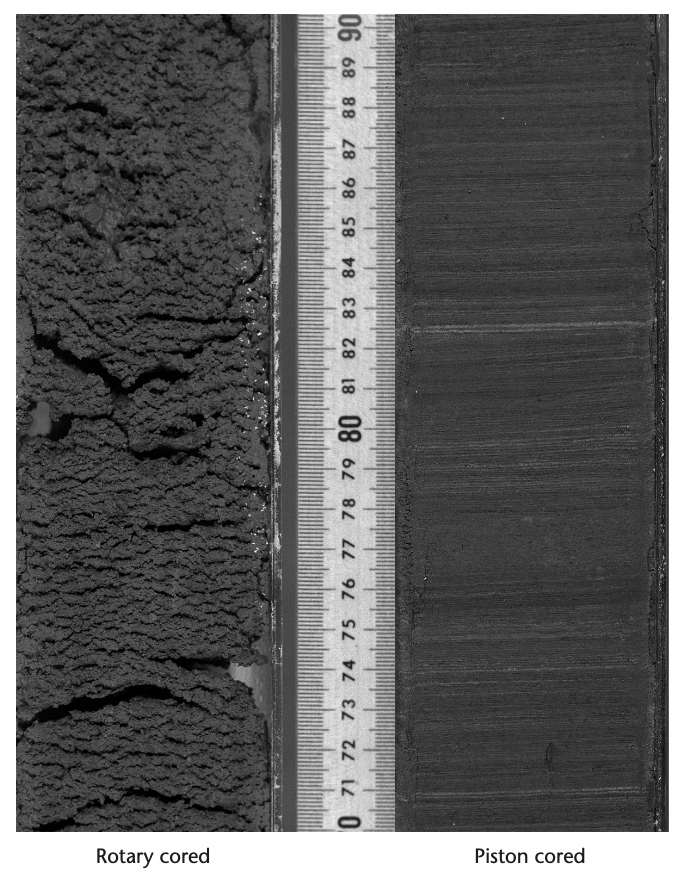
Comparison of core quality between rotary and piston coring. ©IODP
1) Piston Coring - For high resolution climate and paleoceanographic studies. Tools are hydraulically actuated and designed to recover relatively undisturbed samples from very soft to firm sediments. The system fires a core barrel with a cutting shoe ahead of the bit to collect core samples where internal sediment structures remain mostly intact. The hole is then advanced while recovering the sediment core. For one example, see the Advanced Piston Corer (APC) IODP tool sheet and the APC Tool Animation.
2) Rotary Coring - Used in firm sediments to hard rock. Typically deployed when the sediment becomes too hard for piston coring. These systems rely on the rotation of the drill string to advance the hole and trim the core. Internal structures can be lost in sediments that are too firm for piston coring, but still slightly too soft for rotary coring.
Mining Rigs
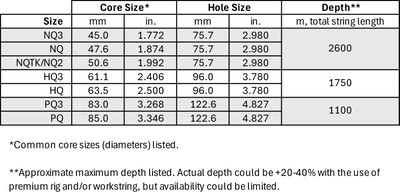
For platforms without a dedicated drilling rig, land-style mining rigs can be mounted. Core sizes vary, but most fall around the typical ~63.5 mm (2.50 in.) in diameter. Core length will be determined by rig and type of coring. These rigs can accommodate piston and rotary coring.
Geotechnical Rigs
Geotechnical vessels often are equipped with integrated drill rigs and wireline coring systems, including piston and rotary coring tools. In addition, multipurpose vessels without dedicated drilling infrastructure can often be equipped with geotechnical rigs. Geotechnical rigs are well suited for drilling on the continental shelf and upper slope. However, these systems are unable to operate in deep ocean environments exceeding water depths of ~2500 m. Expeditions 302, 310, 325, 347, and 381 used geotechnical vessels equipped with rigs.
Seafloor Drills
Seafloor drills are capable of drilling in mid to deep water, up to ~ 4000 m. They can be deployed off a variety of possible operation platforms via a crane or A-frame. Typically, these are remotely controlled and monitored via a fiber optic umbilical. Seafloor drills were used during International Ocean Discovery Program Expeditions 357 and 389. Academic units (e.g. MARUM, BGS) have the capability of drilling up to 200 m below the seafloor, though drilling depths exceeding 55 m are restricted to a maximum water depth of 2500 m. Commercial seafloor drills have the capability of drilling 60 - 120 m below the seafloor. Using piston and rotary coring systems, these drill systems are able to drill and core soft sediments and hard rocks and can have downhole logging, in-situ testing, and/or pressure capture and pressure coring capabilities.
- Water depth: up to 4000 m
- Total depth: up to 200 m into seafloor
- Coring system: rotary and piston
- Environments: can operate on steep slopes of up to 30 degrees and core into hard rock or soft sediments
- Deployment typically requires a maximum wave height of ≤ 3 m
- Deck space: Vessels deploying seafloor drills must be able to accommodate supporting equipment.
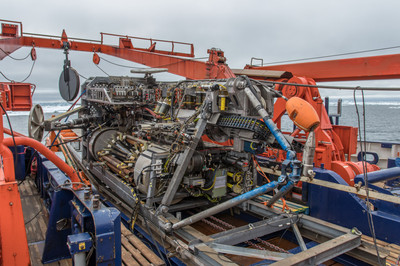
The Marum MeBo seafloor drill on deck after being recovered in the Antarctic Amundsen Sea. Thomas Ronge/SODCO
Downhole logging and borehole tools
Downhole measurement equipment and/or services (e.g., open-hole logging, water sampling) can be made available, pursuant to mission objectives.
Formation temperature and pressure measurements may be made utilizing an APCT-3 style cutting shoe and temperature sensor, or a penetrometer deployed systems such as the SET2 or SETP. The Kuster Water Sampler may be used for obtaining borehole water samples.
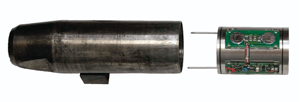
Other equipment or services will be leased/purchased for each mission. These downhole wireline logging parameters can include but are not restricted to magnetic susceptibility, gamma rays, temperature, resistivity, imaging, or vertical seismic imaging. See for example the triple combination downhole logging string.