




Laboratories
The laboratory capabilities for at sea and onshore phases are described below. Containerized laboratories are currently under development to provide a range of capabilities at sea. Remaining analyses will take place onshore at the Gulf Coast Repository.
Containerized Laboratories at Sea
The pool of SODCO laboratory containers is currently under development. More detailed information will be made available once they are operational.
All containerized laboratories are 20’ x 8’ and equipped with heating and air conditioning. Each container will include built-in ethernet ports, Wi-Fi access, Type-B outlets, and computers for operating instrumentation. A typical suite of laboratory equipment will be provided for each container (see below); however, equipment used on each expedition may vary based on scientific needs.
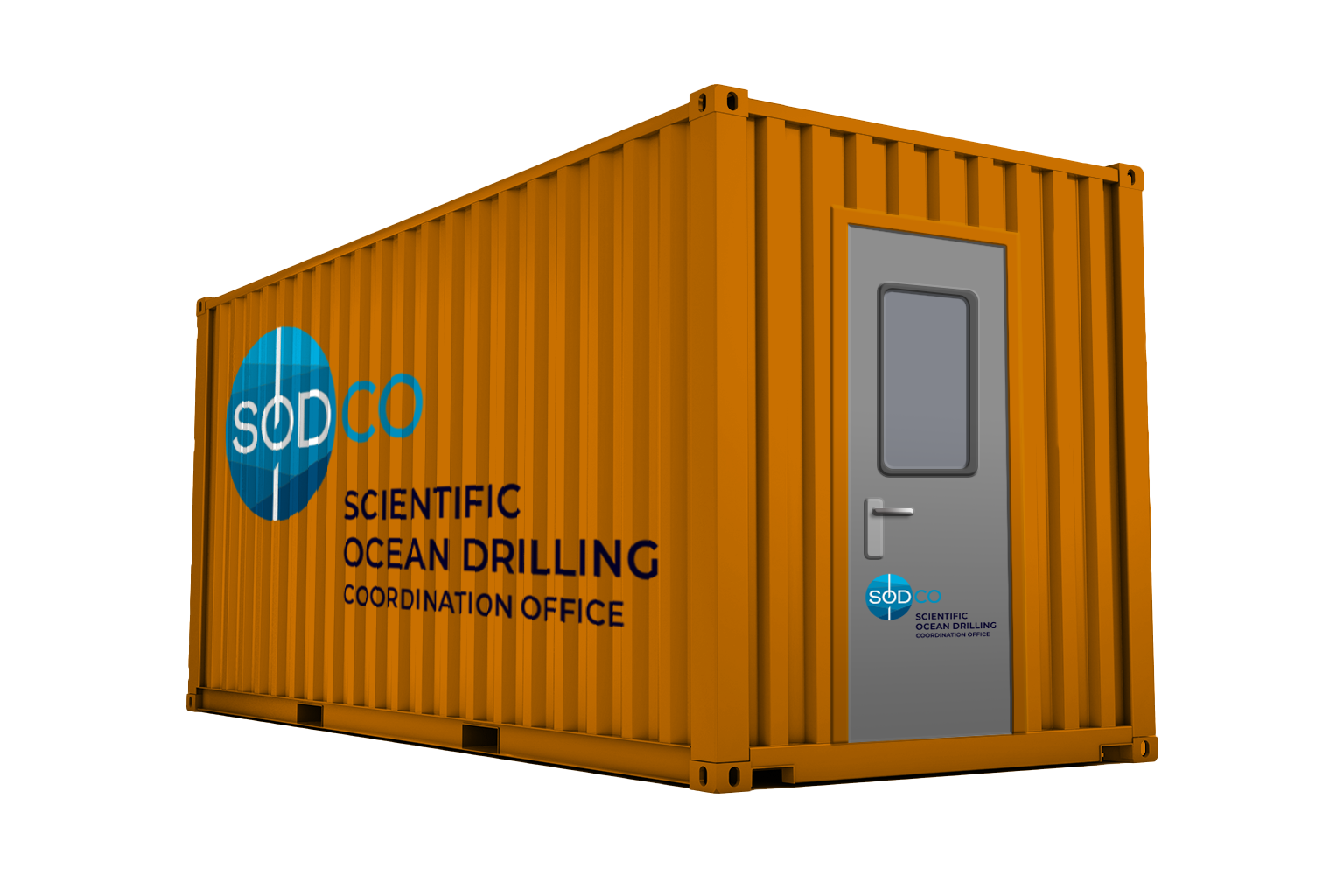
Artist rendering of a SODCO containerized laboratory. Anthony Eason/SOD.
All containerized laboratories are 20’ x 8’ and equipped with heating and air conditioning. Each container will include built-in ethernet ports, Wi-Fi access, Type-B outlets, and computers for operating instrumentation. A typical suite of laboratory equipment will be provided for each container (see below); however, equipment used on each expedition may vary based on scientific needs.
- Physical Properties
The physical properties laboratory container will include a Whole Round Multi Sensor Core Logger (WRMSL). The WRMSL is equipped with sensors for measuring P-wave velocity, density (gamma ray attenuation), and magnetic susceptibility (loop sensor). The container will have custom core drawers for core storage and temperature equilibration.
- Chemistry
The containerized chemistry laboratory will be instrumented with an ion chromatograph (IC) with UV-Vis capabilities; alkalinity and chlorinity titrators; a gas chromatograph (GC) with a hydrogen generator; and a hand held salinometer. The lab includes a fume hood, sink, RO and Milli-Q water systems, an oven, a freezer, and a refrigerator.
- Microbiology
The microbiology lab container will be equipped with a hard-shell anaerobic chamber, an autoclave, incubators, refrigerators, and a -86°C freezer. The container will also include a fume hood, laminar flow hood, KOACH portable clean bench, sink, and an RO and Milli-Q water system.
- Curation
The curation container will house a curation station with label printer, custom core drawers for core storage, and a sink. The container will also include hydraulic presses for sediment interstitial water sampling and an area for photography.
- Information Technology
The IT container will host SODCO servers and the communications infrastructure for internal and external networks. Computer accessories, such as adapters, keyboards, and mice, will be available in the IT container.
- Offices
Depending on the vessel’s configuration and capabilities, SODCO will operate up to two office containers. These containers will provide workspace for SODCO staff and scientists. In addition, these containers can be equipped with Zeiss microscopes for biostratigraphical and sedimentological analyses upon request.
- Third Party Equipment
The use of third-party tools or instrumentation requires coordination with the SODCO. Contact the SODCO-TAMU group for more information (sodco@tamu.edu).
SODCO Expedition Onshore Phase
Following an expedition, the remaining core and sample analyses including core description will take place at the Gulf Coast Repository (GCR) at Texas A&M University in College Station, Texas. The GCR comprises approximately 9,000 square feet of newly renovated, fully instrumented laboratory space and an additional 15,000 square feet of refrigerated storage facilities. The duration of an Expedition Onshore Phase (EOP) is dependent on the amount of core recovered during the expedition. The science party will have access to the entire suite of GCR instrumentation throughout the full duration of the EOP.
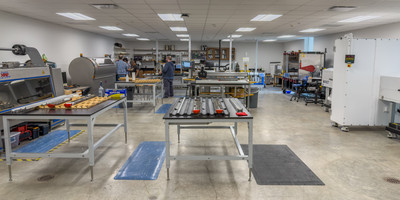
The core laboratory allows for whole-round and split-section analyses for P-wave velocity, density (gamma ray attenuation), magnetic susceptibility, natural gamma radiation, as well as X-ray linescans and computed tomography (CT). Split section analyses include imaging, color reflectance and hyperspectral logging, point magnetic susceptibility, X-ray fluorescence, paleomagnetics, moisture and density, and thermal conductivity.
The geochemistry laboratory is prepared for Inductively Coupled Plasma-Optical Emission Spectrometry (ICP-OES), powder X-ray diffractometry, Carbon Hydrogen Nitrogen Sulfur (CHNS) analysis, ion chromatography, and coulometry.
The microscopy lab is equipped with several upright, stereo, and epifluorescence microscopes, as well as two Scanning Electron Microscopes (SEM), including one equipped with an energy dispersive spectrometer.
Furthermore, EOP participants can make use of correlation and core description software, rock saws, as well as sample preparation facilities.
For a complete list of available GCR facilities and the laboratory layout click here. Instrument procedures and manuals can be found here.