


Navigate Sections
Analytical Facilities
Containerized Laboratories at Sea
The pool of SODCO laboratory and office containers is currently under development. More detailed information will be made available once they are constructed.
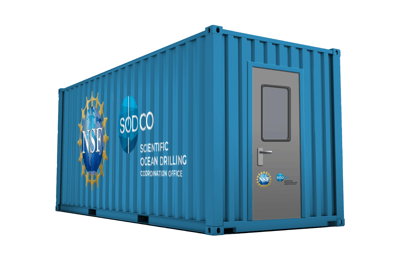
All containerized laboratories are 20' x 8' and equipped with heating and air conditioning. Each container will include built-in Ethernet ports, Wi-Fi access, Type-B outlets, and computers for operating instrumentation. A typical suite of laboratory equipment will be provided for each container (see below); however, equipment used at sea for each expedition may vary based on scientific needs.
Physical Properties
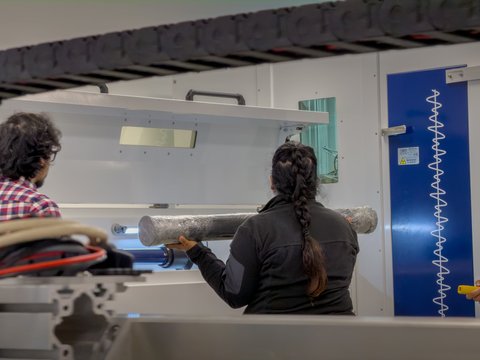
The physical properties laboratory container will include a Whole Round Multi-Sensor Core Logger (WRMSL). The WRMSL is equipped with sensors for measuring P-wave velocity, density (gamma ray attenuation), and magnetic susceptibility (loop sensor). The container will have custom core drawers for core storage and temperature equilibration. Two PCs will allow for simultaneous WRMSL operation, data analysis, and stratigraphic correlation.
Chemistry
The chemistry laboratory will be instrumented with an ion chromatograph (IC) with UV-Vis capabilities; alkalinity and chlorinity titrators; a gas chromatograph (GC) with a hydrogen generator; and a hand-held salinometer. The laboratory includes a fume hood, sink, oven, freezer, and refrigerator, as well as RO and Milli-Q water systems. The container will be equipped with two PCs to operate the GC and IC simultaneously.
Microbiology
The microbiology laboratory container will be equipped with a hard-shell anaerobic chamber, an autoclave, incubators, refrigerators, and a –86°C freezer. The container will also include a fume hood, laminar flow hood, KOACH portable clean bench, sink, and an RO and Milli-Q water systems. One PC will be available for sample entry and data analysis.
Curation
The curation container will house a curation station with a label printer, custom core drawers for core storage, and a sink. The container will also include hydraulic presses for sediment interstitial water sampling and an area for photography.
Information Technology
The IT container will host SODCO servers and the communications infrastructure for internal and external networks. Computer accessories, such as adapters, keyboards, and mice, will be available in the IT container.
Offices
Depending on the vessel’s configuration and capabilities, SODCO will deploy up to two office containers. These containers will provide workspace for SODCO staff and scientists. In addition, these containers can be equipped with Zeiss microscopes for biostratigraphical and sedimentological analyses upon request. The science office container will be equipped with two PCs and two additional monitor-dock combinations that allow scientists to connect their personal laptops.
Third-Party Equipment
The use of third-party tools or instrumentation requires coordination with SODCO. Contact the SODCO-TAMU group for more information (sodco@tamu.edu) and refer to the SODCO Third-Party Tools and Instruments Policy(PDF download). All data generated during an expedition using third party equipment will be considered shipboard data that will be shared with the expedition’s science party and will be published online upon expiration of the expedition’s moratorium.
Expedition Onshore Phase
The majority of core and sample analyses for an expedition, including core description, will take place following the cruise at the Gulf Coast Repository (GCR) at Texas A&M University in College Station, Texas. The GCR comprises approximately 9,000 ft² of newly renovated, fully instrumented laboratory space and an additional 15,000 ft² of refrigerated storage facilities. The duration of an Expedition Onshore Phase (EOP) is dependent on the amount of core recovered during the expedition. The science party will have access to the entire suite of GCR instrumentation throughout the EOP.
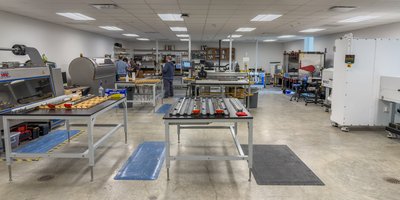
The core laboratory allows for whole-round and split-section analyses for P-wave velocity, density (gamma ray attenuation), magnetic susceptibility, natural gamma radiation, as well as X-ray linescans and computed tomography (CT). Split section analyses include imaging, color reflectance and hyperspectral logging, point magnetic susceptibility, X-ray fluorescence, paleomagnetics, moisture and density, and thermal conductivity.
The geochemistry laboratory contains an Inductively Coupled Plasma-Optical Emission Spectrometer (ICP-OES), powder X-ray diffractometer, a Carbon Hydrogen Nitrogen Sulfur (CHNS) analyzer, ion chromatograph, and coulometers.
The microscopy laboratory is equipped with several upright, stereo, and epifluor microscopes as well as two Scanning Electron Microscopes (SEM), one of which is outfitted with an Energy Dispersive Spectrometry (EDS) unit.
EOP participants can make use of correlation and core description software, rock saws, and sample preparation facilities.
Visit the GCR website for a complete list of available facilities and the laboratory layout. Instrument procedures and manuals are available, as well.