


University of Southern California
TAMU Intern
Benthic Biotic Response to Antarctic Circumpolar Current Dynamics and Patagonian Ice Sheet Instability Across Major Late Pleistocene Glacial to Interglacial Transitions
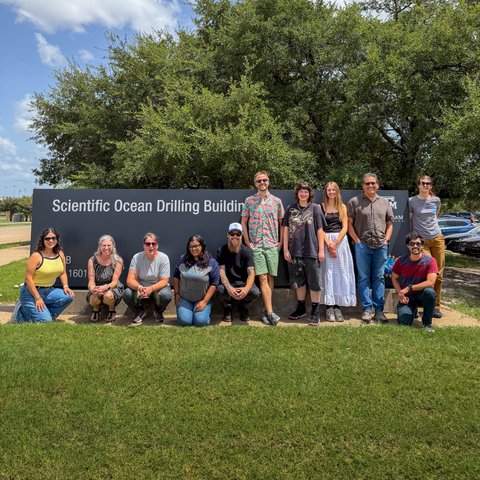
Accepting applications
SODCO offers two opportunities for undergraduates to gain experience in scientific ocean drilling research over the summer. In the SODCO-TAMU internship, two undergraduates work on individual research projects with scientists in the Scientific Ocean Drilling Department at Texas A&M University. In the LDEO internship, SODCO sponsors at least four interns who are accepted to the Lamont-Doherty Earth Observatory summer internship to work on projects related to scientific ocean drilling.
SODCO interns work on individual research projects with scientists at the Scientific Ocean Drilling (SOD) Department of Texas A&M University using the laboratory capabilities at the Gulf Coast Repository (GCR). The GCR houses ~150 km/93 mi of ocean drilling cores from the Pacific Ocean, Gulf of Mexico/Caribbean Sea, and Southern Ocean. Projects will use sedimentary core material and may focus on topics such as: sedimentology, micropaleontology, stratigraphic correlation, geochemistry, physical properties, and data mining.
This is a seven-week, in-person internship at Texas A&M University in College Station, Texas. The internship includes a stipend, housing on the Texas A&M campus, and travel to and from College Station, Texas. There are two internship positions each summer.
Interns will have the opportunity to present their research at a domestic conference of their choosing, such as the Geological Society of America (GSA) or American Geophysical Union (AGU) annual meetings, following the internship. All travel and registration costs will be covered.
The Summer 2027 internship dates are June 7 to July 23, 2027.
During the application period, submit the application form and required documentation. Applications open in November for the following summer.
Application materials:
Academic curriculum vitae (maximum 2 pages)
Personal statement (maximum 2 pages) including the candidate’s:
Scientific interests
Relevant experience in geoscience (can include applicable course work, lab work, working knowledge of software packages, etc.)
Future goals
Expected benefits from the internship
Letter of support from a professor
Must include an assessment of the student’s ability to complete a research-based project
If preferred, the professor may send the letter directly to Leah LeVay at leahlevay@tamu.edu
Two interns will be selected each summer.
Interns will be selected based on their CV, personal statement, letter of support, and interview.
Interviews will be scheduled with the top candidates before the final two intern selections are made.
Interns must be undergraduate students currently enrolled in a U.S. institution.
The internship is in-person, and interns must be available for the entire seven-week program.
Interns are expected to have sufficient background in geoscience, but prior lab experience is not required.
Contact Leah LeVay, SODCO Director of Science Operations at leahlevay@tamu.edu.
SODCO sponsors at least four interns who are accepted to a Lamont-Doherty Earth Observatory (LDEO) internship program to work on projects related to scientific ocean drilling.
LDEO supports two summer undergraduate internship programs:
Lamont Summer Intern Program: open to undergraduates from U.S. colleges and universities
Summer Intern Program for Columbia and Barnard undergraduates: open to undergraduates at Columbia and Barnard
Both programs offer undergraduates the chance to experience cutting-edge scientific research. Interns will have the opportunity to:
Explore scientific research as a career
Develop self-confidence in their independent research, communication abilities, and scientific identities
Form lasting professional relationships with scientists
Research projects are in all areas of Earth, atmospheric, oceanic, and environmental sciences, and follow the diverse disciplinary interests of the students. Students are individually mentored by at least one Lamont scientist.
This is a 10-week, in-person internship in Palisades, NY. The internship includes a stipend, housing, and travel to and from New York.
Interns will have the opportunity to present their research at either the Geological Society of America (GSA) or American Geophysical Union (AGU) annual meetings in the fall following the internship. All travel and registration costs will be covered for SODCO-sponsored interns.
Learn more about the LDEO Intern Programs for Undergraduates.
During the application period, students may apply through the NSF Education & Training Application (ETAP). A list of available projects will be provided, and students will select their top three choices. Applications open in January for the following summer.
Applicants must be undergraduates pursuing an associate or bachelor degree.
The program is open to students who have completed their sophomore or junior year in college with majors (or anticipated majors) in earth science, environmental science, chemistry, biology, physics, mathematics, engineering, sustainable development, or political science. Graduating seniors are not eligible.
Applicants should have an interest in conducting research in the Earth, atmospheric, or ocean sciences.
For detailed eligibility requirements, visit the Lamont Summer Opportunities webpage.
Questions?
Contact Dr. Dallas Abbott or Dr. Michael Kaplan, the LDEO Summer Internship Program Directors.
University of Southern California
TAMU Intern
Benthic Biotic Response to Antarctic Circumpolar Current Dynamics and Patagonian Ice Sheet Instability Across Major Late Pleistocene Glacial to Interglacial Transitions
Wesleyan University
TAMU Intern
Sizing Up Antarctic Legacy Cores: Particle Size Analysis, XRF, Current Speed, and IRD during the Plio-Pleistocene Transition
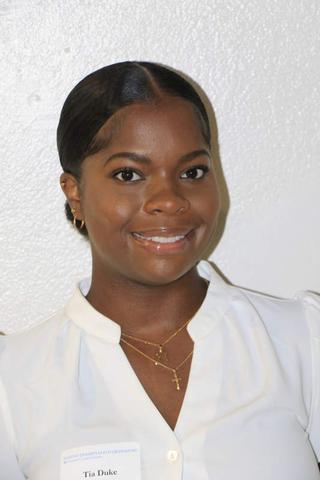
Florida Agricultural and Mechanical University
LDEO Intern
Reconstructing Past El Niño–Like Climate Variability in the Eastern Equatorial Pacific, 120–140 Thousand Years Ago
Tia is a fourth-year Environmental Science student at Florida A&M University. During her summer internship at Lamont-Doherty Earth Observatory, she studied past El Niño-like climate variability in the eastern equatorial Pacific using individual foraminifera shells from Ocean Drilling Program Site 1240. She hopes to pursue a thesis-based master's degree in Environmental Science, focusing on environmental contaminants and water quality, with the goal of working in environmental consulting and risk assessment.
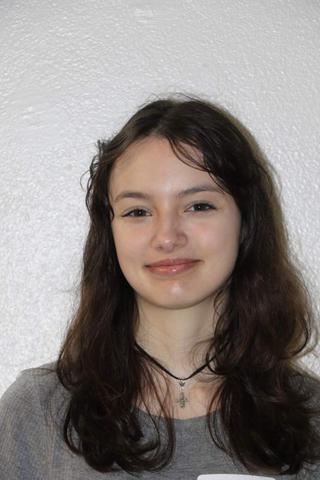
Chatham University
LDEO Intern
Refining the Assessment of Ice Rafted Debris Using Combined X-Ray Imaging and Sedimentology
Makayla is an undergraduate Environmental Science major with an interest in paleoclimatology and geology. After graduating, she hopes to pursue a master's degree or start a research position working on past climate research. In her free time, she enjoys reading, listening to and playing music, and traveling.
Rowan University
LDEO Intern
How Has Atlantic Deep Ocean Circulation Changed in the Last 50,000 Years?
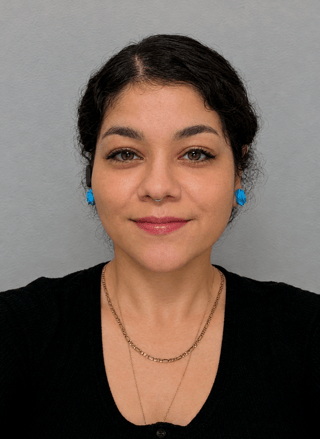
Housatonic Community College
LDEO Intern
When and Why have Earthquakes Propagated to the Seafloor at the Japan Trench?
Carmen is a geology student from Connecticut with a passion for natural disasters and seismology. At the Lamont-Doherty Earth Observatory, she analyzed sediment core samples from the Japan Trench to determine their age and mineralogical composition. After earning her bachelor's in Earth Science at SCSU, she plans to pursue a PhD to contribute to a deeper understanding of Earth's processes while exploring opportunities in space and interplanetary geology.
SODCO has supported undergraduate interns since Summer 2025.