


Navigate Sections
Guiding Documents
Several recent planning documents and reports have been prepared by and for the scientific ocean drilling community. These documents identify key scientific areas where ocean drilling can have the biggest impact in advancing knowledge of earth, planetary, and life sciences. Scientists are encouraged to refer to these documents as they consider and plan for U.S. supported scientific ocean drilling activities, including expeditions, workshops, and other activities.
2050 Science Framework
The 2050 Science Framework outlines long-term science goals for scientific ocean drilling. Developed through a multi-phase international planning and writing process, the Framework represents the priorities and objectives of the science community. Hundreds of scientists from more than 20 countries were involved in creating the 2050 Science Framework, through planning workshops, writing, and peer review.
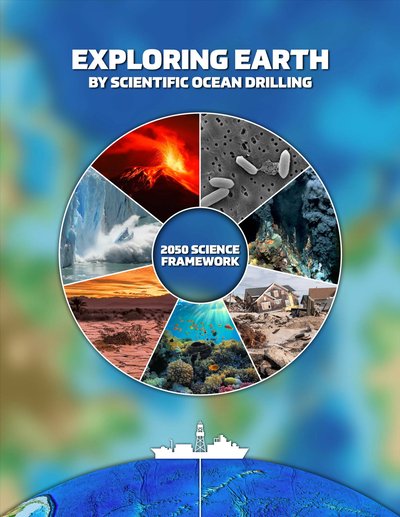
The Framework is organized into seven Strategic Objectives, five Flagship Initiatives, and four Enabling Elements. The Strategic Objectives cover broad research areas related to interconnections within the Earth system. They are intentionally wide-ranging and aspirational to allow new science to emerge through bottom-up proposal development and peer review. The Flagship Initiatives are long-term research efforts that encompass multiple Strategic Objectives and inform societally-relevant issues. The Enabling Elements are research partnerships and related endeavors that facilitate and enhance scientific ocean drilling’s success.
The 2050 Science Framework is available in full, as a 12-page brochure, and as a 2-page pamphlet.
Advancing Future Ocean Drilling in the United States (FOCUS)
Advancing Future Ocean Drilling in the United States (FOCUS) was a community effort to identify priorities for U.S. scientific ocean drilling in the first phase of post-IODP drilling. Led by a steering committee of the U.S. Science Support Program and the U.S. Advisory Committee, FOCUS gathered broad community input through a series of virtual meetings and one in-person workshop. This document reports on the scientific priorities identified through this process, with an eye toward addressing critical U.S. societal and economic challenges.
The FUTURE of the US Marine Seafloor and Subseafloor Sampling Capabilities
This document reports on the outcomes of the 2024 FUTURE workshop, which was convened to chart a path forward for seafloor and subseafloor sampling capabilities. Motivated by the declining capacity of U.S. marine sampling infrastructure, including the retirement of the JOIDES Resolution, the workshop sought to identify the most critical gaps in research capabilities and what infrastructure is required to fill them most efficiently. Scientific drilling platforms were identified as mission critical for the six scientific themes assessed in the workshop: Ocean-Seafloor Interfaces, Solid Earth Processes, Ridge-Axis Processes, Deep Crust Processes, Climate and Anthropogenic Activities, and High Latitude Science.
National Academies Consensus Study Report on Progress and Priorities in Ocean Drilling
This report reviewed the previous decade’s progress in addressing high priority science questions with scientific ocean drilling and identified priority research questions for the future. The report focused on scientific areas that require scientific ocean drilling to access the samples and data needed for advancement, that have transformative or paradigm-shifting potential (vital), and that are related to time-sensitive societal issues (urgent). The report also discusses how legacy assets can be leveraged most effectively and what infrastructure and workforce capabilities are essential to future drilling activities. Published in 2024, this is an interim report from the National Academies of Sciences, Engineering, and Medicine’s Committee on the 2025–2035 Decadal Survey of Ocean Sciences.
Forecasting the Ocean: The 2025–2035 Decade of Ocean Science
This Consensus Study Report from the National Academies identifies priority research areas for the Ocean Sciences Division at NSF (OCE). In addition to discussing the top ocean science research priorities, the report discusses the need for innovative approaches and investments in infrastructure to address those priorities. For scientific ocean drilling, the report identifies vital and urgent science themes and the priority activities for a U.S. drilling program. The report makes recommendations for maximizing the value of legacy assets, developing short- and long-term drilling infrastructure, and sustaining international collaboration.