


Navigate Sections
History of Scientific Ocean Drilling
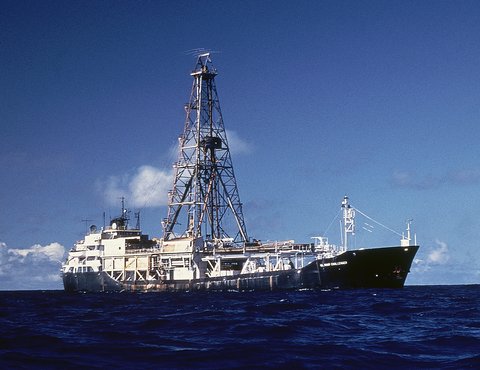
Project Mohole (1958-1964)
Project Mohole was an ambitious, U.S.-led precursor to modern scientific ocean drilling, initiated by the American Miscellaneous Society (AMSOC) and funded and overseen by the U.S. National Science Foundation (NSF). Conceived to drill through the oceanic crust and directly sample the mantle across the Mohorovičić discontinuity (“Moho” – the seismic boundary between Earth’s crust and mantle), it relied primarily on a single converted drilling barge, CUSS I, operated by engineers from Global Marine in collaboration with oil-industry partners and with scientific participation from institutions such as Scripps Institution of Oceanography and Lamont Geological Observatory. Its 1961 test near Guadalupe Island demonstrated the first successful deep-ocean drilling using dynamic positioning—maintaining a vessel’s position over deep water without anchoring—and recovered basaltic material from beneath marine sediments, confirming the feasibility of offshore crustal drilling. Despite these technological breakthroughs and considerable public interest (driven in part by a widely read article by John Steinbeck in Life magazine), escalating costs, management difficulties, and controversy over its governance structure—particularly the balance of control among academia, government, and industry—led to its cancellation in 1966 before reaching the mantle. Nevertheless, Project Mohole established the engineering foundation and scientific rationale for scientific ocean drilling and laid the groundwork for the Deep Sea Drilling Project.
Deep Sea Drilling Project (1966-1983)
The Deep Sea Drilling Project (DSDP) was the first sustained phase of scientific ocean drilling, funded primarily by NSF and operated by Scripps Institution of Oceanography using a single dedicated drillship, the Glomar Challenger. Scientific planning and oversight were carried out through the Joint Oceanographic Institutions for Deep Earth Sampling (JOIDES), a U.S.-based consortium formed by Lamont Geological Observatory, Woods Hole Oceanographic Institution, Scripps Institution of Oceanography, and the University of Miami, which developed drilling proposals, set scientific priorities, and staffed expeditions, establishing a community-based advisory model that endured in later programs. In 1975 the program expanded into the International Phase of Ocean Drilling (IPOD), adding international funding and participation from the United Kingdom, the Federal Republic of Germany (West Germany), France, Japan, and the Soviet Union, along with additional participation from other European countries through collaborative arrangements, while retaining the JOIDES planning structure. Over more than a decade of global drilling, DSDP provided the first direct tests of seafloor spreading and plate tectonics by documenting systematic age progression of oceanic crust away from mid-ocean ridges, confirming key predictions of the plate tectonics. It also established microfossil biostratigraphy and paleomagnetism as global stratigraphic tools, revealed the history of ocean circulation and climate change from deep-sea sediment records, and advanced understanding of marine geology, geochemistry, and the structure of the oceanic crust. Major engineering advances included the development of re-entry capability (using seafloor-installed re-entry cones to return to and deepen previously drilled holes) and the introduction of the hydraulic piston corer (HPC), which enabled recovery of long, relatively undisturbed sediment cores and revolutionized paleoceanographic studies.
Ocean Drilling Program (1983-2003)
The Ocean Drilling Program was a fully international phase of scientific ocean drilling, funded principally by NSF with major participation from Japan, Canada, and a European consortium coordinated by the European Science Foundation, including the United Kingdom, France, Germany, and other member states. Operations were conducted using the purpose-built riserless drillship JOIDES Resolution, which replaced the Glomar Challenger and provided substantially enhanced capabilities, including improved dynamic positioning, greater drilling depths, and advanced coring systems such as the advanced piston corer (APC), extended core barrel (XCB), and rotary core barrel (RCB), enabling high-quality recovery across a wide range of lithologies. Scientific planning continued through the Joint Oceanographic Institutions for Deep Earth Sampling (JOIDES), while overall program management was carried out by Joint Oceanographic Institutions under contract to NSF. ODP achieved major advances across Earth science, including high-resolution reconstructions of Cenozoic climate variability and abrupt climate change from continuous sediment sequences, refined models of ocean circulation and its role in climate evolution, detailed characterization of the structure and composition of the oceanic crust and upper mantle, new insights into subduction-zone processes and fluid flow, and the discovery and characterization of extensive subseafloor microbial ecosystems, fundamentally expanding understanding of the deep biosphere.
Integrated Ocean Drilling Program (2003-2013)
The Integrated Ocean Drilling Program marked a transition to a multi-platform, globally coordinated approach to scientific ocean drilling, supported by three primary implementing organizations and an expanded international partnership. The program was funded chiefly by NSF, Japan through the Japan Agency for Marine-Earth Science and Technology (JAMSTEC), and a European consortium organized as the European Consortium for Ocean Research Drilling (ECORD), with additional participation from China, South Korea, and India, and with Australia and New Zealand joining through the newly formed Australian-New Zealand IODP Consortium (ANZIC) during this phase. Centralized scientific planning and overall program integration were coordinated by Integrated Ocean Drilling Program Management International (IODP-MI), while drilling operations were carried out by three complementary platforms: the U.S.-operated riserless drillship JOIDES Resolution, extensively refitted to provide advanced laboratory capabilities and high-recovery coring; the riser-equipped Japanese drillship Chikyu, capable of deep drilling into active tectonic settings with controlled circulation and borehole stability; and European-led mission-specific platforms (MSPs), which enabled drilling in environments inaccessible to conventional drillships, including shallow waters, ice-covered regions, and continental margins. This multi-platform strategy allowed IODP to target a much broader range of geological settings than previous programs. Scientifically, IODP produced major advances in understanding earthquake and subduction-zone processes through direct sampling and observatories in active fault systems (notably the Nankai Trough); recovered a broader range of deep biosphere communities, quantifying their extent and activity; generated high-resolution records of past climate and ocean change; and advanced knowledge of crustal formation, hydrothermal systems, and fluid flow, significantly expanding the scope and impact of scientific ocean drilling.
International Ocean Discovery Program (2013-2024)
The International Ocean Discovery Program continued scientific ocean drilling within a reorganized, fully international framework that eliminated central international management and distributed responsibilities among the primary funding agencies and implementing organizations. The program was supported by NSF, JAMSTEC, and ECORD, with continued participation from China, South Korea, India, and ANZIC, and new membership from Brazil. Drilling operations retained the multi-platform approach established in the previous phase, with the riserless JOIDES Resolution, the riser-equipped Chikyu, and ECORD-led mission-specific platforms enabling access to a wide range of marine and continental-margin environments. Scientific planning was coordinated through an updated international advisory structure (an international Science Evaluation Panel and three Facility Boards that developed drilling schedules for each platform), maintaining the community-driven proposal system without a single overarching management entity. The program achieved major advances in understanding earthquake mechanics and slow-slip processes through long-term observatories in subduction zones; refined records of past climate variability, including monsoons and ice-sheet dynamics; expanded knowledge of subseafloor life and its limits; and improved constraints on crustal formation and fluid circulation. The phase also marked a significant transition in infrastructure, culminating in the retirement of the JOIDES Resolution in 2024, closing a nearly four-decade chapter of riserless drilling operations and signaling a shift toward new platform strategies in future programs.
Scientific Ocean Drilling Today (2025-present)
The next phase of scientific ocean drilling involves changes to both the programmatic structure and technological capabilities in this new phase of scientific ocean drilling. In the U.S., expeditions will utilize mission-specific platforms (MSPs) as plans are considered for a new dedicated drilling vessel. Expeditions and related activities are funded through the NSF Subseafloor Sampling Program (S3P) and implemented through the NSF Scientific Ocean Drilling Coordination Office (SODCO). Internationally, ECORD and Japan have formed the International Ocean Drilling Programme (IODP3). IODP3 implements expeditions using MSPs and the Chikyu, as well as projects using legacy cores and data. Although not formally under one program, international collaboration remains vital to scientific ocean drilling. The scientific priorities for this phase are informed by the 2050 Science Framework, which was developed collaboratively through an international planning and writing process. The 2050 Science Framework outlines six foundational research areas for scientific ocean drilling: Habitability and Life on Earth; The Oceanic Life Cycle of Tectonic Plates; Earth’s Climate System; Feedbacks in the Earth System; Tipping Points in Earth’s History; Global Cycles of Energy and Matter; and Natural Hazards Impacting Society.