


September 22, 2026
The role of granite in mantle processes
A new paper describes the primary sources of sediment input to the Iberian Margin.
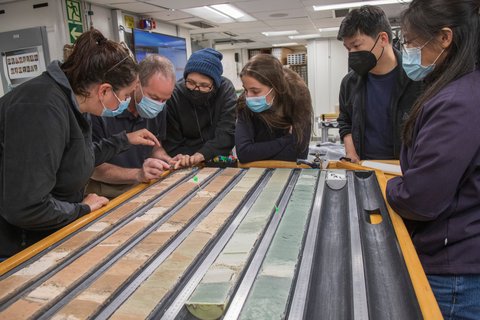
IODP Expedition 397 drilled into the Iberian Margin off the coast of Portugal to access a remarkably detailed climate record buried beneath the seafloor. This region receives sediments from multiple sources, leading to high accumulation rates. This creates a rich record, but it also makes it difficult to identify the original source of the sediment.
Focusing on the last 250 thousand years, a new study integrated clay mineralogy, grain-size data, and end-member modeling to distinguish between different possible sources. The authors identified three major sources: Iberian sediments delivered by river, North African dust delivered by wind, and particulate material from the Mediterranean Sea delivered by ocean currents. African dust appears to have been the dominant source, but its relative contribution varied with climate conditions linked to North African humidity and wind patterns.
The study was published in Paleoceanography and Paleoclimatology.
September 22, 2026
The role of granite in mantle processes
September 3, 2026
Exploring life in the rocky subseafloor
August 20, 2026
3,500 years of hydrothermal activity around the Santorini Caldera